The 2016 Kaikōura Earthquake: New Zealand's Most Complex Rupture
The magnitude 7.8 Kaikōura earthquake of November 2016 ruptured at least 21 faults simultaneously — a geological event unprecedented in recorded history. Its lessons are reshaping how scientists model seismic hazard worldwide.
The Most Complex Earthquake Ever Recorded
At 12:02 AM on 14 November 2016, a magnitude 7.8 earthquake struck near the small coastal town of Kaikōura on New Zealand's South Island. Two people died directly from the earthquake, and one person died from a heart attack. Given the magnitude, the low casualty count was remarkable — a testament to New Zealand's modern building standards and the timing (the middle of the night, when most people were in bed).
What made the Kaikōura earthquake scientifically extraordinary was not its magnitude but its complexity. Detailed analysis of the rupture revealed that the earthquake had ruptured at least 21 separate faults over a period of approximately 70–90 seconds. The rupture propagated from the epicentre near Waiau in a north-east direction, jumping from fault to fault across a distance of approximately 180 km.
This multi-fault rupture was unprecedented in the instrumental record and challenged fundamental assumptions about how earthquakes work.
The Tectonic Setting
Kaikōura sits at the northern end of the South Island, in a region of exceptional tectonic complexity. The plate boundary transitions here from the Alpine Fault (a transpressional fault running along the west coast) to the Hikurangi subduction zone (where the Pacific Plate dives beneath the Australian Plate on the east coast). The region is a tangle of faults, many of which were poorly mapped before 2016.
The earthquake occurred on a combination of strike-slip and reverse faults, with the rupture propagating through the Marlborough Fault System — a network of major faults including the Hope, Kekerengu, and Needles faults — before eventually triggering slip on the subduction interface itself.
The Multi-Fault Rupture
The standard model of earthquake rupture assumes that an earthquake occurs on a single fault or a simple fault system. The Kaikōura earthquake violated this assumption spectacularly.
Geodetic data (GPS and satellite radar), seismological analysis, and field mapping combined to reveal a rupture that:
- Initiated on the Humps Fault near Waiau
- Propagated north-east through at least 21 separate faults
- Jumped across fault gaps of up to 15 km — far larger than previously thought possible
- Triggered slip on the Hikurangi subduction interface, approximately 60 km offshore
The total surface rupture length was approximately 180 km, with individual fault segments showing up to 12 metres of horizontal displacement.
Physical Consequences
The physical consequences of the Kaikōura earthquake were dramatic:
Coastal uplift. Parts of the Kaikōura coastline were uplifted by up to 6 metres, stranding marine life on newly exposed rock platforms. The uplift was so rapid that the local crayfish industry was temporarily destroyed — the crayfish habitat had been lifted above the water.
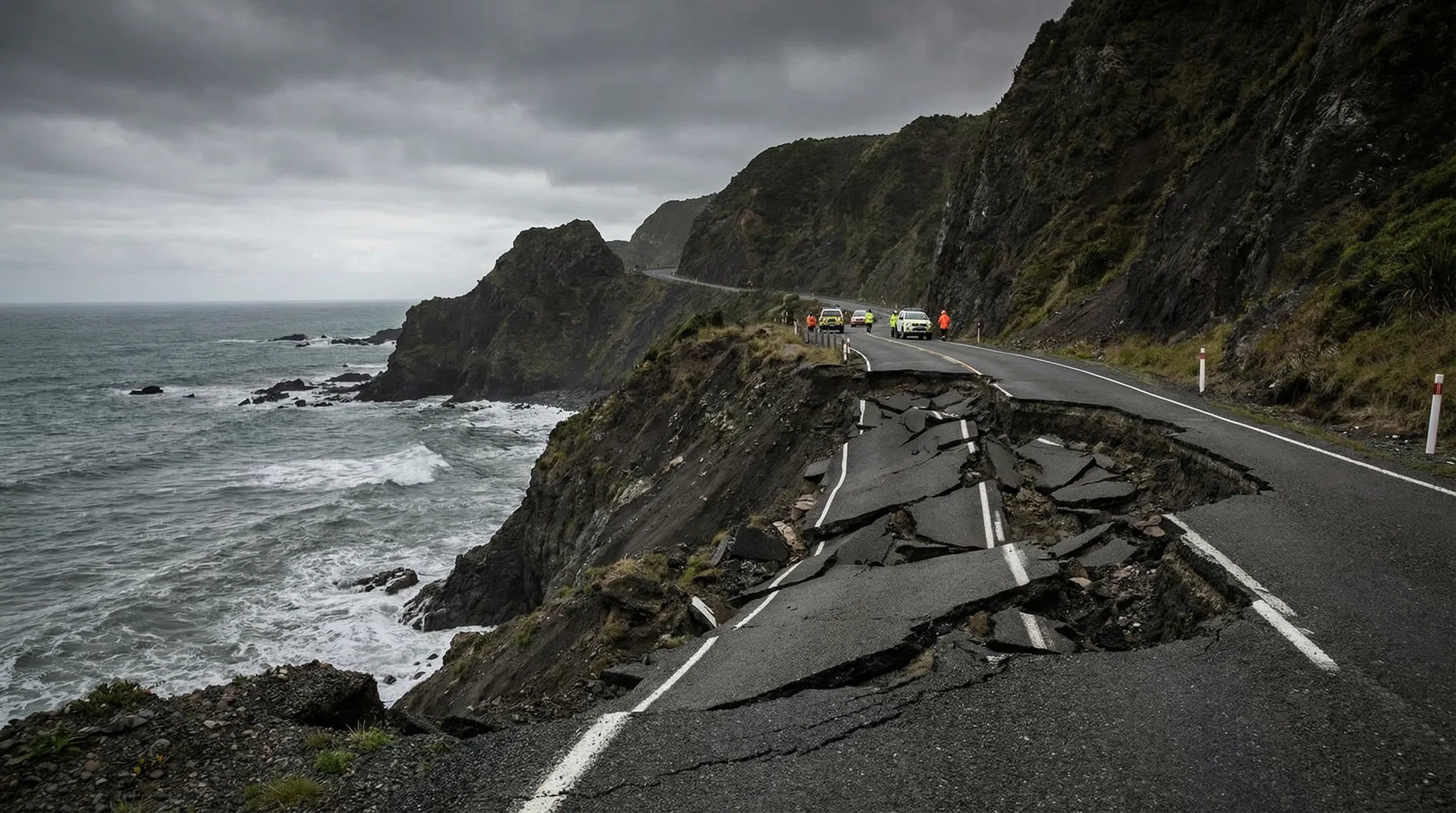
Landslides. Thousands of landslides were triggered across the Kaikōura Ranges, blocking State Highway 1 and the main trunk railway line. The road and rail corridor was closed for months, isolating Kaikōura by land.
Tsunami. A small tsunami was generated by the coastal uplift and submarine landslides. Waves of up to 7 metres were recorded at some coastal locations, though the tsunami was not widely destructive.
Infrastructure damage. The State Highway 1 and the KiwiRail main trunk line — the only land connections between Christchurch and Picton — were destroyed in hundreds of locations. The road was reopened after approximately two months; the railway took over a year.
Implications for Seismic Hazard Assessment
The Kaikōura earthquake has significant implications for how seismic hazard is assessed, both in New Zealand and globally:
Multi-fault ruptures are more common than previously thought. The assumption that earthquakes occur on single faults underestimates the potential magnitude of earthquakes in complex fault systems. This has led to revisions of the New Zealand National Seismic Hazard Model, with increased hazard estimates for some regions.
Fault connectivity matters. The ability of ruptures to jump between faults depends on the geometry of the fault system and the stress conditions. Understanding fault connectivity is now a priority for seismic hazard research.
Ground motion prediction is challenging for complex ruptures. The ground motion from the Kaikōura earthquake was highly variable and difficult to predict using standard ground motion models. This has implications for the accuracy of probabilistic hazard assessments.
Lessons for Building Design
The Kaikōura earthquake provided valuable data on the performance of modern New Zealand buildings:
Modern buildings performed well. Buildings designed to NZS 1170.5 generally performed as intended, with life safety maintained even in areas of strong shaking.
Older buildings were more vulnerable. Unreinforced masonry buildings and pre-1976 buildings (designed before modern seismic standards) suffered disproportionate damage.
Non-structural damage was significant. Even in buildings that remained structurally sound, non-structural damage — fallen ceiling tiles, displaced partitions, damaged services — caused significant disruption and cost.
Liquefaction occurred in unexpected locations. Liquefaction was triggered in some areas that had not been identified as high-risk in pre-earthquake assessments, highlighting the limitations of current liquefaction hazard mapping.
Sources: Hamling et al. (2017) "Complex multifault rupture during the 2016 Mw 7.8 Kaikōura earthquake, New Zealand"; GNS Science Kaikōura earthquake research; New Zealand National Seismic Hazard Model revision.